
Improper lifting techniques are a common cause of back pain and back injuries. Once injured, recovery tends to be a long and often expensive process. According to Injury Facts 2015, back injuries accounted for 177,580 of the 905,690 injuries reported in the private sector, with over exertion and cumulative trauma being the biggest factors leading to injury. 20% of all work injuries in warehouses involve problems with the back even though the proper techniques are always clearly instructed.
It is important to remember that a lifting injury can happen at any time, not just at work but also at school, home, or even in public spaces. So please remember to look for any potential hazards when lifting. Asses the weight of the object, test the load by pushing on it lightly with your hands or feet. How easy it moves tells you how heavy it is, so you could decide to lift it manually or with some form of lifting aid. Do not try to carry a big load alone; always ask for help.
Here are some quick tips on how to do manual lifting safely:
- Wide Base of Support
Square up to the load with feet placed shoulder-width apart, one foot slightly ahead of the other.
- Squat, Don’t Bend
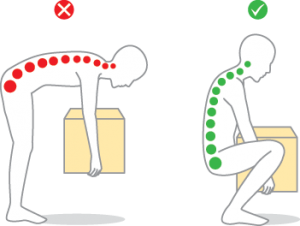
Never bend over when picking up a heavy object. Always bend at the knees and keep your back straight.
Squat down, only bending at the hips and knees.
- Maintain Good Posture
Look straight ahead and keep your back straight. Push your chest out and pull your shoulders back, this will help you maintain the correct posture.
- Lift
Slow and smooth; Maintain good posture while using your arms, legs, and core body (abdominal muscles) to lift.
- Never Use Your Back
Neither for lifting nor carrying, never use or bend your back.
- Avoid Awkward Load Positioning
Hold the load close to your body at the level of your belly button. Lead with your hips as you change direction. Keep shoulders in line with hips as you move.
- Put Down
Put your load down carefully, squatting down with hips and knees only. Remember: DO NOT bend your back.
- Take a Break
After lifting a heavy load take some time to rest and have a glass of water. This gives your back a chance to recover and reduces the chance of injury.
The below video, posted by Dr. Jacob Harden on Instagram, illustrates the strain that is placed on the back when improper lifting techniques are used and compares this to the correct lifting techniques.
If you frequently work with heavy items and engage in lifting activities, it is important that you have a warm-up routine prior to lifting. Strict adherence to this warm up routine will help lessen the risk of injury. If an unexpected back injury does occur, please stop normal physical activity for the first few days after the injury. Apply ice for the first 48 to 72 hours, then follow up with heat to the affected area, these actions will help to alleviate your symptoms and reduce swelling (inflammation) in the area of pain. Sleep in a curled-up, fetal position with a pillow between your legs. If you usually sleep on your back, place a pillow or rolled towel under your knees to relieve pressure. Do not do activities that involve heavy lifting or twisting of your back for the first 6 weeks after the pain begins.
If heavy lifting and manual handling is a frequent task in your work, Samson Tiara can help. We offer a Manual Handling safety course that covers hazard identification and mitigation, proper lifting techniques and assistive devices. For more information you are welcome to contact us at marketing@survival-systems.com.
References & Further Reading
Five Proper Lifting Technique Tips, Premier Handling Solutions
http://premierhandling.com/proper-lifting-technique-tips/
Materials Handling: Heavy Lifting, Occupational Safety & Health Administration (OSHA)
https://www.osha.gov/SLTC/etools/electricalcontractors/materials/heavy.html
Do You Know How to Lift and Carry Safely?, National Safety Council
http://www.nsc.org/learn/safety-knowledge/Pages/Lift-and-Carry.aspx
Lifting Safety: Tips to Help Prevent Back Injuries, FamilyDoctor.org
https://familydoctor.org/lifting-safety-tips-to-help-prevent-back-injuries/
Proper Lifting Technique, WebMD.com
http://www.webmd.com/back-pain/proper-lifting-technique
Taking Care of Your Back At Home, MedlinePlus
https://medlineplus.gov/ency/article/002119.htm

